The Challenge.
Following September 11, 2001, the Millennium Hilton — located directly across from the site — remained closed for 18 months. The challenge: manage a highly sensitive reopening that balanced luxury hospitality with the emotional reality of a grieving neighborhood, while signaling the dynamic rebirth of Lower Manhattan.
Millennium Hilton
The Insight.
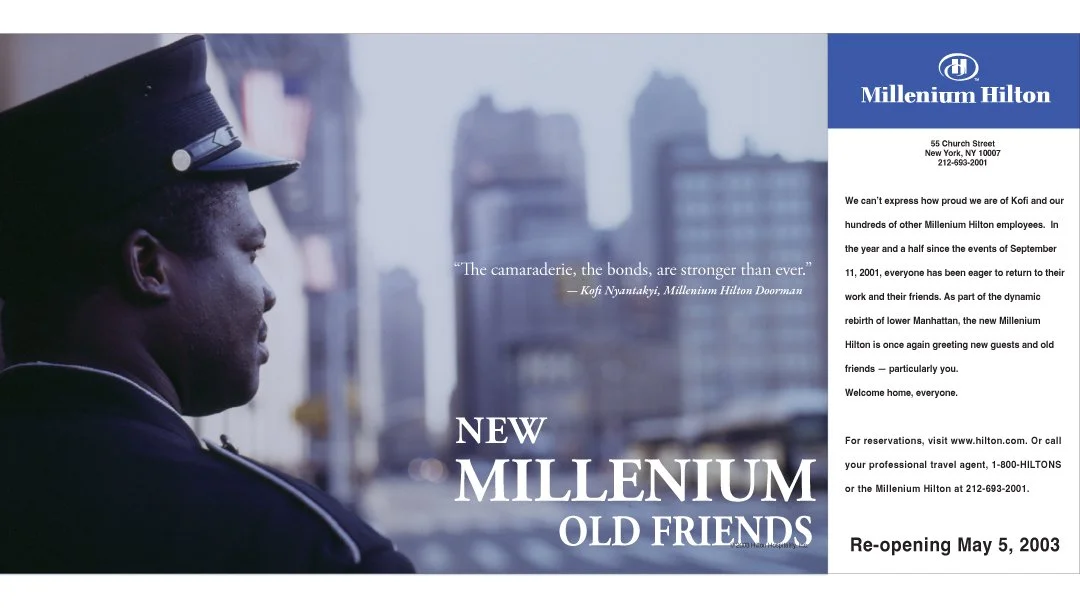
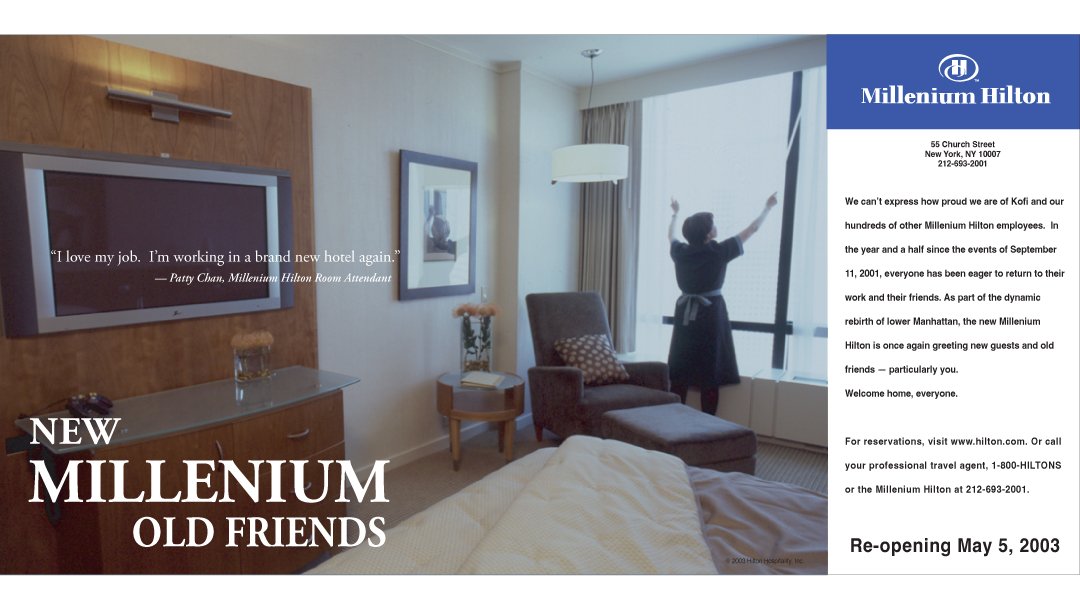
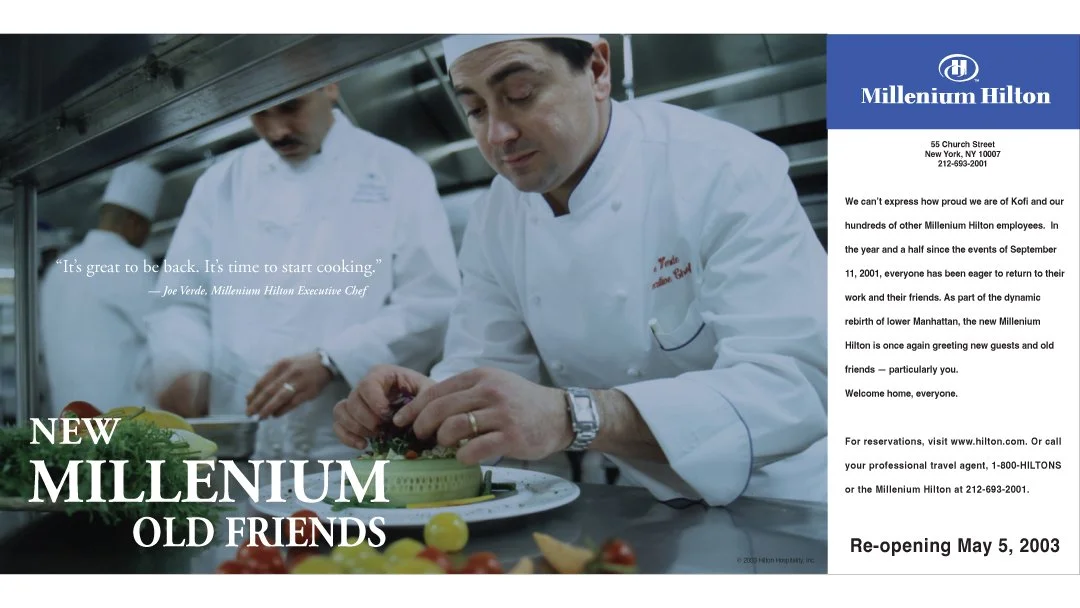
The campaign couldn't be about the hotel. It had to be about the people. With 95% of the original staff returning, the story was already there — Joe the Chef, Patty the Room Attendant, Kofi the Doorman. Real faces of recovery in a city that needed to see them.
The Result.
The hotel successfully reopened May 5, 2003, as a symbol of New York's endurance. The campaign ran across print, radio, OOH, subway stations, bus, and phone kiosks — a fully integrated effort in collaboration with Rubenstein PR. The cultural impact went beyond advertising: Kofi the Doorman became one of the most recognized hotel doormen in New York City. Strangers would stop on the street to ask if he was Kofi. That's not a campaign result. That's a campaign that became part of the city.
The Strategy.
The creative decision to move away from polished architectural photography was the entire campaign. Luxury hospitality advertising in 2003 was all gleaming lobbies and aspirational lifestyle — we went the opposite direction entirely. Real employees, real names, real faces. The work was developed in close collaboration with Rubenstein PR, one of New York's premier public relations firms, who led the radio, OOH, and media strategy while we directed the visual system — ensuring every touchpoint from subway platform to phone kiosk to tabloid print carried the same human warmth and consistent identity. The "New Millennium, Old Friends" campaign had to work at 8 inches in a newspaper and 8 feet on a bus shelter simultaneously — typography warm and grounded, never corporate. The "Welcome Home" emotional register was the throughline across every channel. What nobody predicted was that the campaign would make Kofi the Doorman genuinely famous — people walking up to him on the street, recognizing him by name. When a real person in a campaign becomes a New York character, the work has done something beyond advertising.